
Prediction Markets vs. Sports Betting
At some point last year, something quietly broke in the language we use to talk about betting.
It happened gradually, then all at once -- the way most cultural shifts do. Sports bettors started calling their picks "positions." Degenerate gamblers started calling themselves "traders." People who used to brag about hitting a parlay started talking about "closing line value" and "market efficiency." And on the other side, financial analysts who had spent careers explaining derivatives to institutional clients found themselves being asked by journalists to explain why someone on Polymarket had just put $400,000 on whether Nicolas Maduro would be removed from power by February.
The vocabulary was bleeding. The categories were collapsing. And the interesting question isn't which side won -- it's what that collapse tells us about where we are right now, and where this is all going.
This piece isn't about how to use Polymarket. It's about what Polymarket represents. What it means that betting on a football game and betting on a Federal Reserve decision are now happening on the same platform, priced by the same mechanism, by people who increasingly can't quite explain which one they're doing.
The Old World Had Clean Lines
For most of living memory, betting and investing were legally, culturally, and psychologically distinct activities. Not because they were philosophically different -- both involve putting money on an uncertain outcome and collecting if you're right -- but because society decided they needed to be treated differently and built separate systems to enforce it.
Gambling was regulated at the state level, confined to casinos and racetracks, and later to licensed sportsbooks operating under strict geographic and product restrictions. It was entertainment. It was a vice, for some. It was working class. It was Las Vegas and Atlantic City and the bookie who took your uncle's money every Sunday.
Investing was regulated federally, accessible through brokerages, attached to real productive assets -- companies, governments, property -- and surrounded by an elaborate infrastructure of disclosures, fiduciary duties, and fraud protections. It was serious. It was wealth-building. It was the financial advisor in the office park who told your parents to max out their 401k.
The line between them was policed aggressively. You could not bet on elections. You could not bet on interest rate decisions. You could not, in most states, bet on sports from your phone until a Supreme Court decision in 2018 changed that. The two worlds had different regulators, different language, different social meaning, and different customers.
What Polymarket and its competitors have done is build a single platform that makes both of those things look identical. And in doing so, they've forced a question that nobody in either the gambling or the financial world has a clean answer to: what exactly is the difference?
The Platform Doesn't Know Either
Log into Polymarket on any given Tuesday and here's what you might see on the front page.
"Will the Lakers beat the Celtics tonight?" Sitting right next to "Will the Federal Reserve cut rates at the May meeting?" Sitting right next to "Will Donald Trump pardon Ross Ulbricht before March?" Sitting right next to "Will MrBeast's next video get 70 million views in its first week?"
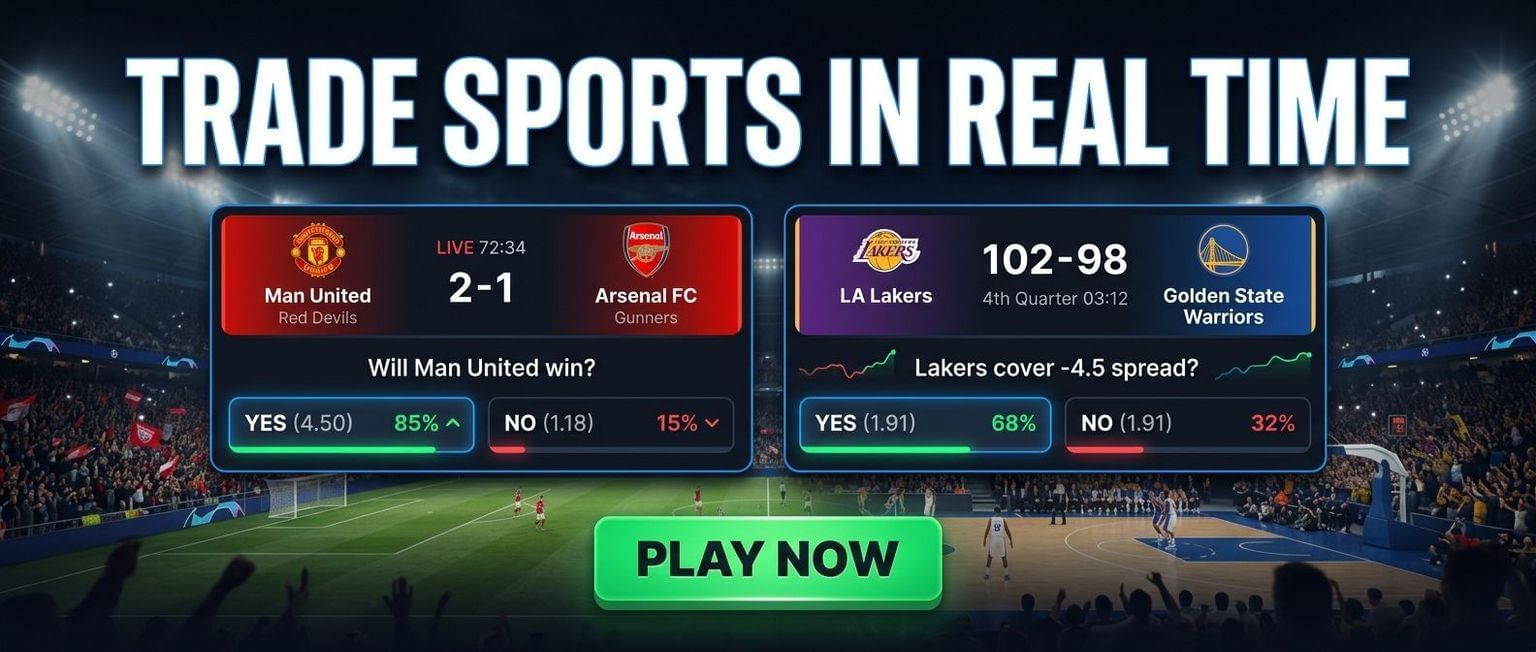
Same interface. Same YES/NO share structure. Same dollar prices representing implied probabilities. Same settlement mechanism. The platform makes no distinction between a basketball game, a central bank decision, a presidential pardon, and a YouTube video. They are all just markets. They all just resolve to zero or one dollar.
This is not an accident. It is the point. The entire philosophical bet Polymarket is making -- and the Kalshi founder has said this directly -- is that everything is a prediction market. Every financial asset is really just a claim on an uncertain future outcome. A stock is a prediction that a company will generate future cash flows. A bond is a prediction that a government will remain solvent. An options contract is a prediction about where a price will be on a specific date. Prediction markets have just stripped away the complexity and showed the underlying structure bare.
That framing is intellectually provocative, and it has real merit. But it also creates a category problem that is proving genuinely difficult to resolve, legally, regulatorily, and psychologically.
When you put $500 on the Lakers tonight, you are gambling. When you put $500 on a Federal Reserve rate decision, are you also gambling? The market structure is identical. The only difference is the underlying event. And yet one of those things has been socially acceptable in financial circles for decades -- interest rate futures have traded on the Chicago Mercantile Exchange since 1976 -- while the other was until very recently illegal in most of the United States.
The sportsbooks want you to think there's a meaningful distinction, by the way. They have lobbyists actively arguing that prediction markets are just gambling in a different dress, and that they should face the same state-level gaming regulations. This argument is entirely self-interested -- DraftKings and FanDuel built empires under the existing regulatory framework and have no desire to compete with platforms that don't pay state taxes, don't need gaming licenses in 35 jurisdictions, and have no structural interest in limiting winning customers. But the argument is not entirely wrong, either. The line really is blurry. Blurrier than either side wants to admit.
Betting Used to Have a Culture. Now It Has a Market.
Here's what's actually changed, and it's bigger than the regulatory debate.
For generations, betting had a specific cultural texture. It was communal. You watched the game with people. The bet was part of the experience -- it made you care more, it gave you a stake in something you'd be watching anyway. Losing $50 on a Sunday game was almost a social transaction: you paid your part of the entertainment cost, you shared the risk with other fans, and the money changed hands in a context that was understood by everyone involved. The bet was attached to something. A team. A player. A moment you were going to remember.
What prediction markets offer is fundamentally different. They offer detached, continuous, instrument-like exposure to outcomes. You're not watching the game because you love the team. You're monitoring a position. You're looking at a probability curve. You're thinking about when to exit relative to the closing price. The event -- the game, the election, the Fed meeting -- is the underlying asset. Your relationship to it is financial, not emotional.
This is not a small shift. It's a rewiring of why you care about things.
A wealth manager quoted recently in a financial trade publication put it well when he said that prediction markets are conditioning people to expect immediacy, frequent feedback, and binary outcomes from their financial decisions. The psychology of the bet -- the discrete event, the wait, the result -- is being replaced by the psychology of the trade: the continuous price, the mark-to-market, the option to exit.
Some people find this more exciting. You're not just waiting for a buzzer. You're active. You can react to information. You can cut losses. You can ride a position that's going your way and decide exactly when to take profit. It feels less like gambling and more like something.
What that something is, exactly, nobody has quite agreed on.
The Media Noticed and Didn't Know What to Do With It
One of the clearest signals that prediction markets have crossed into the cultural mainstream is what happened to journalism around them.
In December 2025, Kalshi signed partnerships making it the "official prediction market partner" of both CNN and CNBC. The two biggest American cable news networks started incorporating prediction market probabilities into their news coverage -- not as a curiosity or a sidebar, but as data. As though a Kalshi price on whether a bill would pass was the same kind of information as a Congressional Budget Office score or a polling average.
Polymarket went a different direction but made the same point. It signed on as the "exclusive prediction market partner" for the Golden Globes broadcast, with real-time market-driven probabilities displayed during the awards show.
Think about what that means for a second. A financial instrument derived from people betting money on which movie wins an award was presented to millions of viewers as a meaningful data point during a live television event. It was treated as information. As a signal worth watching.
The media didn't really know how to frame this because there isn't an existing frame that fits cleanly. Is a Polymarket price a poll? Not quite -- it's driven by financial incentives rather than opinion surveys. Is it gambling odds? Sort of -- but it's peer-to-peer and without a house margin, which makes it structurally different from a sportsbook line. Is it a market price, like a stock or a futures contract? Technically yes -- but the underlying event is a movie award, which makes it feel absurd to call it financial.
The honest answer is that it's all three things and none of them completely, and the media handled this mostly by just... showing the number and moving on. The number felt authoritative in a way that was difficult to argue with, because money was behind it, and it was updating in real time, and it was usually close to right.
That felt new. That felt like something had changed.
The Thing Nobody Wants to Say Out Loud
There is a version of the prediction market story that is genuinely exciting. Markets that aggregate real information from participants with real financial incentives. Better forecasting tools than polls or expert opinion. A mechanism for making uncertainty legible and tradable. A way for people who are right about things to get paid for being right, instead of just being right in a Twitter thread that nobody reads.
The early academic literature on prediction markets -- going back to the Iowa Electronic Markets, which has been running election forecasting markets since 1988 -- was genuinely promising. These markets did outperform polls in many cases. The reason made intuitive sense: people with skin in the game pay attention differently. They update faster. They don't hold views for social or tribal reasons when money is on the line.
That promise is real, and it hasn't disappeared.
But there is also a version of this story that is less comfortable, and it's worth sitting with.
When Polymarket was running markets on nuclear detonations following the beginning of the Iran conflict in early 2026, and nearly $2 million was bet on whether Israel and Iran would exchange nuclear strikes, that wasn't information aggregation. That was people putting money on the possibility of catastrophic mass death. The market was eventually removed after most of the bets were placed. But its existence, and its liquidity, raised a question that the "prediction markets are truth machines" framing doesn't have a clean answer to.
What does it do to our relationship with terrible events when we have a financial position in them?
The Armchair Trader, a financial media outlet, reported that psychologists studying this space have found what they call "identity-based loss" in prediction market participants -- where financial outcomes become proxies for self-esteem and worldview. Losing a bet on a political outcome, they found, can feel like a personal rejection in a way that losing a sports bet usually doesn't. Because the political bet was also a statement about who you are and what you believe. The money was just how you kept score.
That's a different kind of engagement with world events than we had before. Whether it's better or worse depends on your priors. But it's different, and pretending it isn't is dishonest.
The Incumbents Are Scared, and That Tells You Something
Watch the behavior of the incumbents when you want to understand whether a disruption is real.
DraftKings and FanDuel have both launched their own prediction market products. DraftKings acquired a startup called Railbird specifically to build its offering. FanDuel partnered with the CME Group -- the Chicago Mercantile Exchange -- to ready its own app. Robinhood, the retail brokerage that democratized stock trading, added prediction markets and had its customers trade 2.5 billion prediction market contracts in October 2025 alone. PrizePicks and Underdog, major daily fantasy operators, launched prediction market products within months of each other.
These companies are not doing this because they believe prediction markets are philosophically superior. They are doing it because they watched Polymarket and Kalshi grow explosively, saw the user behavior data, and recognized that something in the engagement model was different. People were coming back more often. They were spending more time in the app. They were talking about their positions the way they used to talk about their fantasy teams.
Kalshi's transaction volume was 1,680% higher in 2025 than in 2024. Not a typo. The NHL became the first major professional sports league to formally partner with both Kalshi and Polymarket. Google announced a deal to integrate prediction market data into Google Finance. The platform that started as a crypto-native experiment for political forecasting was now embedded in the infrastructure of mainstream American financial information.
The incumbents are building their own versions and simultaneously lobbying to have the originals regulated out of existence. That combination -- compete and kill -- is what established industries do when they're threatened by something they can't simply ignore. It's what the taxi industry did with Uber. It's what the record labels did with streaming. It's what traditional bookmakers in the UK did with betting exchanges when Betfair launched in 2000.
Betfair won. Not completely, not without scars, but the exchange model proved durable because it offered something the traditional model structurally couldn't match. The question for Polymarket is whether the same thing happens here.
The Legal Fight Is Really a Cultural Fight in Disguise
On paper, the regulatory battle over prediction markets is about jurisdiction. Is an event contract a commodity derivative regulated by the CFTC, or is it a gambling product regulated by state gaming commissions?
That question is real and consequential. But it is also a proxy for something deeper: who gets to define what betting is, and whether the people who built their businesses on the old definition get to veto the new one.
A bipartisan group of US senators announced legislation in March 2026 to ban sports betting on prediction markets. The casino lobby, the sportsbook operators, and Native American tribal gaming interests -- who hold exclusive gambling rights in many states and see prediction markets as an existential threat -- have coordinated legal challenges in more than 20 jurisdictions. A Massachusetts court found that prediction market sports contracts functioned as illegal sports wagering. Nevada, Arizona, Michigan, and Ohio have all issued warnings or taken action.
Meanwhile, a California court sided with Kalshi, ruling that because it's regulated under the CFTC, state gambling law doesn't apply. The CFTC itself has treated prediction markets as derivatives, not gambling products. The platforms have high-powered political connections -- both Kalshi and Polymarket hired Donald Trump Jr. as an adviser in 2025 -- and access to serious legal resources.
This fight is headed to the Supreme Court eventually. That's almost certain. And when it gets there, the court will have to answer a question that is not really legal in nature. It will have to answer: what is a bet?
Is it defined by the underlying event? Then betting on a football game is gambling but betting on an interest rate decision is finance. Is it defined by the mechanism? Then peer-to-peer exchanges are fundamentally different from books even if the events are the same. Is it defined by intent? Then the same contract is gambling if you bought it for entertainment and a derivative if you bought it for hedging.
None of those answers are entirely satisfying. And the fact that we don't have a clear answer is itself the most interesting thing about this moment.
What Actually Changed, and Why It Matters for You
If you're someone who bets -- on sports, on anything -- the cultural shift we're describing has a practical dimension worth paying attention to.
The definition of what you're doing is in flux. Not just legally. Culturally. The activity of putting money on an uncertain outcome used to have a relatively fixed social meaning. That meaning is now contested, and the contest has real consequences for how the activity is taxed, regulated, discussed, and perceived.
A majority of Americans, according to a recent AIBM/Ipsos survey, still describe prediction markets as gambling rather than investing. The industry is spending significant resources trying to change that perception, because the regulatory and tax treatment of the two categories is very different. How that perception war plays out will shape what these platforms look like in five years -- which markets they can offer, which states they can operate in, what your winnings are called when you file your taxes.
The question of insider trading has gone from theoretical to urgent in a way that directly affects market integrity. When Polymarket came under scrutiny in early 2026 for suspiciously timed bets on US military action in Iran and Venezuela -- a trader made nearly $1 million on positions placed with apparently precise advance knowledge -- it wasn't just a compliance problem. It raised the question of whether these markets can actually function as honest information aggregators when participants with genuine advance knowledge can profit anonymously. Polymarket rewrote its rules. But rules are only as good as enforcement, and an expert on gambling law quoted in a major daily newspaper noted the obvious: athletes who want to bet on their own sports don't do it themselves. They get a friend to do it. It's hard to police.
And the media integration -- prediction market prices embedded in news coverage, displayed during award shows, incorporated into Google Finance -- changes the meaning of what a market price signals. When a probability displayed on CNN during an election is itself drawing viewers who might then trade on it, who might be trading on the information that other people are watching, you get a feedback loop that the original academic literature on prediction markets didn't anticipate. These are no longer small, clean forecasting mechanisms. They are large, heavily trafficked, media-integrated platforms where the line between observing a probability and affecting it has blurred significantly.
None of this makes prediction markets bad. It makes them complicated in ways that matter.
The Bet Has Been Repriced
Here's where we actually are.
Betting on real-world events has existed for as long as humans have cared about outcomes. What's new is the infrastructure -- the ability to create a continuous, liquid, transparent, peer-to-peer market for almost any question, accessible from anywhere, settling in hours, with no house taking a cut.
That infrastructure changes things. It changes the economics (no vig, no limits on winners). It changes the psychology (position management instead of waiting for a result). It changes the culture (outcomes as assets, events as underlying instruments). And it changes what we mean when we say someone is a "bettor" versus a "trader" versus an "investor" -- categories that used to be clearly separated and are now, increasingly, the same person looking at the same screen.
The people who built their business models on the old separation are fighting hard to maintain it, through lobbying and lawsuits and competing products. The people who built Polymarket and Kalshi are arguing -- with considerable evidence -- that the separation was always somewhat artificial, that they've just removed the friction.
Both things are true, which is what makes this genuinely interesting.
The bet, as a cultural object, is being repriced. The comfortable certainty that gambling was one thing, investing was another, and never the twain would meet -- that certainty is gone. What replaces it is still being negotiated, in courtrooms and congressional offices and platform terms of service and the daily choices of millions of people deciding what to call the thing they're doing when they open their phone and put money on whether tomorrow's news will be what they think it will be.
Whether that's progress depends on what you were hoping for.
But it is, without question, a change.